
Cheaters Are Breaking Games, Trust, and the Will to Queue
Cheaters. Look, let’s be real for a hot second here. If you’ve touched any competitive game in the last, oh, I don’t know, decade, you’ve probably run into that one player who’s somehow getting headshots through walls or moving at superhuman speeds. You know the type—the ones who make you question your sanity and wonder if you should just go back to playing single-player games where the only thing cheating is your save file.
Well, guess what? You’re not imagining things, and you’re definitely not alone in your frustration. A recent report from PlaySafe ID just dropped some absolutely mind-boggling statistics that’ll make your blood boil faster than a poorly optimized game launch.
The Numbers Don’t Lie—And They’re Depressing
Here’s the kicker: 80% of gamers have encountered gaming cheaters in online games. Eighty percent! That’s not a small minority of unlucky players—that’s practically everyone who’s ever dared to click “Find Match” in their favorite competitive title.
But wait, it gets worse (because of course it does). Out of those players who’ve had their gaming experience ruined by cheaters, a whopping 42% have considered rage-quitting their favorite games entirely. Can you blame them? There’s nothing quite like spending your hard-earned money on a game only to have some script kiddie ruin your evening with their fancy wall hacks.
And here’s where it really hits developers where it hurts, their wallets. A staggering 55% of players have either stopped spending money on microtransactions or drastically reduced their in-game purchases because they’ve lost faith in the game’s integrity. That’s right, gaming cheaters aren’t just ruining your K/D ratio (that took so much effort, cries internally); they’re literally destroying the gaming economy one rage-quit at a time. Great job, for an easy win, you would wreck everything…
Gaming Cheaters: The Plague That Never Goes Away
Now, before you start thinking this is some newfangled problem brought on by modern gaming, let me stop you right there. Gaming cheaters have been around since the dawn of multiplayer gaming. Remember the good old days of Counter-Strike 1.6? Yeah, those weren’t actually that good when half the server was using aim assists that would make professional esports players weep.
The difference now is scale and sophistication. We’re not talking about simple speed hacks anymore (though those still exist, unfortunately). Today’s gaming cheaters have access to incredibly advanced tools that can bypass even the most robust anti-cheat systems. It’s like an arms race, except one side keeps bringing nukes to a knife fight.
Take Escape from Tarkov, for example. Despite the developers banning thousands upon thousands of cheaters every few weeks, the game’s community sentiment is at rock bottom. Players are fleeing faster than rats from a sinking ship, and honestly? I don’t blame them one bit.
The Psychology Behind the Madness
Here’s something that’ll make you lose even more faith in humanity: 62% of surveyed gamers admitted they’ve been tempted to cheat. Sixty-two percent! That means more than half of the gaming community has, at some point, looked at a cheater demolishing lobbies and thought, “You know what? Maybe I should join them.”
It’s like a twisted version of peer pressure, except instead of trying cigarettes behind the school gym, people are downloading aimbots behind their gaming monitors. The logic is frustratingly simple: if you can’t beat ’em, join ’em. But here’s the thing—that mentality is exactly how we ended up in this mess in the first place!
Even Brand-New Games Can’t Escape
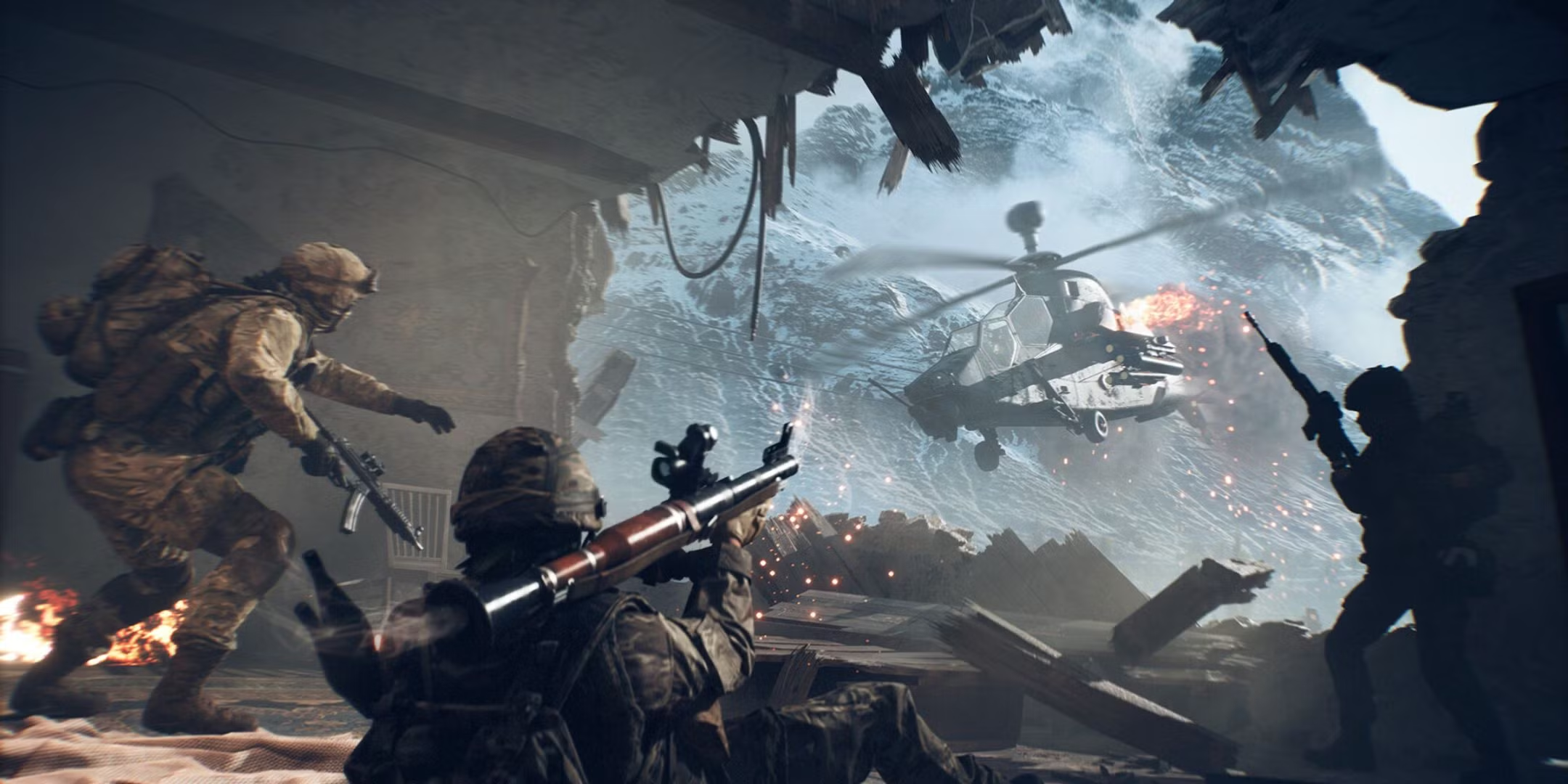
You’d think that brand-new games would be safe from gaming cheaters, right? Wrong! The recent Battlefield 6 beta had cheaters within hours of going live. Hours! These people work faster than Amazon Prime delivery, and honestly, that’s both impressive and deeply concerning.
It’s like watching someone spray-paint graffiti on a building that’s still under construction. The audacity is almost admirable if it weren’t so infuriating.
The Identity Crisis Solution
Now, here’s where things get interesting. PlaySafe ID surveyed over 2,000 gamers across the US and UK, and found that 71% of players would be willing to verify their identity with an accredited verification company to combat gaming cheaters. That’s a pretty significant number of people willing to sacrifice some anonymity for the sake of cleaner lobbies.
Think about it—we already verify our identities for banking, social media, and even food delivery apps. Why not gaming? Sure, there are privacy concerns, but when the alternative is dealing with rage-inducing cheaters every other match, suddenly ID verification doesn’t sound so bad.
The Developer Dilemma
Game developers are caught between a rock and a hard place here. They’re spending ridiculous amounts of money on anti-cheat systems that gaming cheaters seem to crack faster than you can say “VAC ban.” It’s like trying to build a dam while someone upstream keeps throwing dynamite in the water.
Some companies are getting creative, though. Rainbow Six Siege has implemented increasingly sophisticated detection methods (ahem catalouging all the tricks), and Call of Duty has been experimenting with various approaches to combat gaming cheaters. But for every step forward developers take, the cheat creators seem to take two.
The Ripple Effect on Gaming Culture
The impact of gaming cheaters extends far beyond just ruined matches. They’re fundamentally changing how we approach competitive gaming. Players are becoming more suspicious, more cynical, and frankly, less trusting of legitimately skilled players.
How many times have you watched a killcam and immediately assumed someone was cheating, even when they might have just made a genuinely good play? Gaming cheaters have poisoned the well of competitive gaming to the point where exceptional skill is often met with accusations rather than admiration (no more bragging about trck shots for fear of perma-ban).
What’s Next for Online Gaming?
The future of online gaming hangs in the balance, and honestly, it’s not looking super bright right now. With gaming cheaters becoming more sophisticated and more prevalent, something’s got to give. Either developers figure out a way to get ahead of the curve, or we’re going to see a massive exodus from competitive gaming.
Maybe that’s overly dramatic, but when 42% of players are considering quitting because of cheaters, we’re clearly approaching a tipping point. The question isn’t whether something will change—it’s whether that change will come from the developers, the gaming community, or the cheaters themselves finally getting bored and moving on to ruin someone else’s hobby.
Until then, we’re all stuck in this frustrating cycle of hoping our next match will be clean while mentally preparing for the inevitable encounter with someone whose idea of fun involves ruining everyone else’s experience. Isn’t online gaming just wonderful?