
Why Netcode Could Make or Break Riot’s 2XKO
Alright, let’s talk about something that can make or break a fighting game: netcode. We’ve all been there, right? You’re in a high-stakes match, your fingers are flying, you’ve perfectly timed your combo… and then lag. The screen freezes, your inputs get eaten, and suddenly you’re on the receiving end of a beatdown you didn’t deserve. It’s the stuff of nightmares for any fighting game fan. So when Riot Games announced their League of Legends fighter, 2XKO, and started dropping hints about its online play, the community held its collective breath.
After years of whispers, speculation, and a name change from Project L, the 2XKO closed beta is finally in the hands of players. And let me tell you, the single most shocking thing isn’t the flashy combos or seeing Yasuo get perfected—it’s the netcode. It is, and I don’t say this lightly, buttery smooth.
Is 2XKO’s Netcode Really That Good?
As someone who has suffered through the laggy hellscape of games like Super Smash Bros. Ultimate online, where a bad connection can make the game feel like a slideshow, jumping into 2XKO was a revelation. It felt… local. Like my opponent was sitting right next to me, trash-talking and all. The connection was so seamless that for a second, I forgot I was even playing online.
But hey, don’t just take my word for it. The internet is already buzzing. A Reddit thread asking players what surprised them most about the beta is basically a love letter to Riot’s engineers.
One user gushed, “The netcode is just phenomenal.” Another claimed, “This might be too early to say, but it feels on par with the best netcode I’ve played with.” My personal favorite comment has to be, “If you’re wired, there’s basically no difference to playing local.” That’s the dream, isn’t it? That’s the holy grail of online fighting games.
Why Does This Matter for 2XKO?
So, why are we all geeking out over something as nerdy as netcode? Because it’s the foundation of any competitive online game. A fighting game can have the most balanced roster, the most intricate mechanics, and the flashiest graphics, but if playing it online feels like wrestling with a dial-up modem, it’s dead on arrival.
A flawless online experience is a massive green flag for a game like 2XKO, which is clearly aiming to be a major force in the esports scene. Riot Games has a reputation for building rock-solid multiplayer experiences (Valorant, anyone?), but even with their track record, it’s still impressive to see a fighting game get it this right, this early. So many AAA developers with decades of experience still can’t nail a functional multiplayer system, yet here’s Riot, waltzing in and setting a new standard.
What Else Did We Learn from the 2XKO Beta?
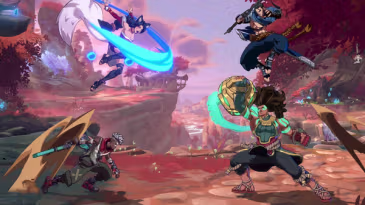
Beyond the god-tier netcode, the closed beta gave us a deeper look into the game’s mechanics. The 2v2 tag-team system feels incredibly dynamic. You can call in your partner for an assist, swap them in to save you from a nasty combo, or unleash a “Fuse” attack where both champions go wild on screen for a cinematic, high-damage special. It has the chaotic energy of Marvel vs. Capcom but with Riot’s signature polish and readability.
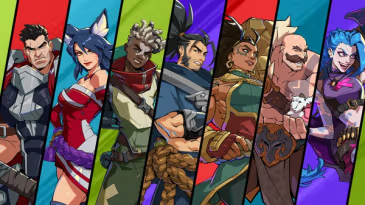
The beta also introduced Vi and Blitzcrank to the roster, who joined fan-favorites like Ahri, Ekko, and Yasuo. Each character feels distinct and true to their League of Legends roots, from Ekko’s time-bending resets to Illaoi’s space-controlling tentacles.
The game is still a work in progress, with the closed beta acting as a “soft launch” that will run indefinitely until the full release. Progress will be wiped, but the feedback Riot is gathering now is invaluable. If this early taste is anything to go by, 2XKO isn’t just coming to compete; it’s coming to shake up the entire fighting game community.
For more gaming content visit Total Apex Gaming