
NVIDIA G‑Sync Pulsar Promises 1,000 Hz‑Level Clarity on 360 Hz Monitors
NVIDIA didn’t just show up to CES 2026 — it walked in like it had something to prove. And honestly? It kind of did. After two years of teasing, demoing, and dangling the promise of “future‑proof motion clarity,” G‑Sync Pulsar is finally real, shipping in actual monitors. Not dev kits. Not prototypes. Real hardware you can buy.
And the pitch is bold: effective motion clarity equivalent to a 1,000 Hz monitor, even though the panels themselves top out at 360 Hz.
That’s not marketing fluff — that’s NVIDIA essentially saying, “What if your monitor could cheat physics?”
The War on Motion Blur Just Escalated
Motion blur has always been the silent saboteur of competitive gaming — the thing you don’t notice until you do, usually right after you miss a headshot. NVIDIA’s original G‑Sync Pulsar already tried to fix this by strobing the backlight between frames, but the new version goes way deeper.
Instead of flashing the entire backlight at once, Pulsar now uses “Regional Backlight Pulsing” — ten horizontal stripes that strobe in sync with the panel’s scanout, like a wave rolling down your screen.
Why does that matter?
Because it means:
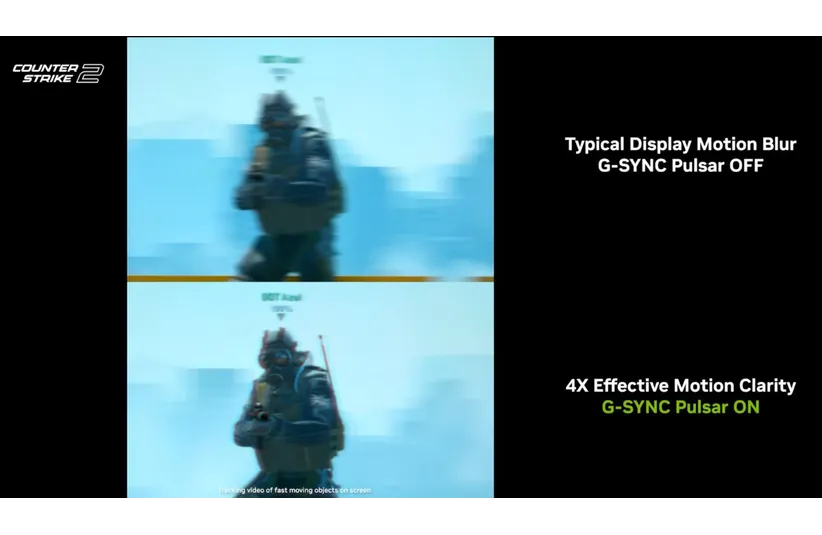
- Each frame is only visible for 25% of the frame time
- Object hold time is 4× shorter
- Motion clarity is effectively 4× higher than your refresh rate
In plain English:
A 360 Hz monitor suddenly feels like a 1,000 Hz monitor.
That’s not a metaphor. That’s NVIDIA’s own claim — and it’s backed by the physics of how your eyes track motion.
ULMB Walked So Pulsar Could Run
Video of G-SYNC Pulsar video, Courtesy of the NVIDIA GeForce channel
Backlight strobing isn’t new. ULMB and ULMB 2 already tried to solve motion blur, but they had one fatal flaw: they only worked at fixed refresh rates. The moment your framerate dipped, the whole thing fell apart.
Pulsar fixes that by syncing the strobing to variable refresh rates, meaning you get:
- Tear‑free frames
- No flicker
- No stutter
- Maximum clarity
All at the same time.
This is the holy grail monitor nerds have been chasing for a decade.
The First Wave of Pulsar Monitors Is Built for Sweatlords
NVIDIA isn’t pretending this is for casual players. The first four Pulsar monitors are all:
- 27‑inch
- 1440p
- 360 Hz
- IPS panels
- From Acer, AOC, ASUS, and MSI
These are esports‑tier displays — the kind you buy when you’re tired of blaming your monitor for your K/D.
They’re only at select retailers, starting at $599.
Ambient Adaptive: Your Monitor Now Watches Your Room
Alongside Pulsar, NVIDIA is rolling out G‑Sync Ambient Adaptive, which uses a built‑in sensor to automatically adjust brightness and color temperature based on your room lighting.
Think of it like True Tone, but for people who spend 12 hours a day in Valorant.
It’s not flashy, but it’s the kind of quality‑of‑life feature that quietly becomes essential.
The Big Picture: NVIDIA Wants to Make 1,000 Hz Feel Normal
So, here’s the story:
We’re nowhere near true 1,000 Hz monitors being mainstream. But NVIDIA is tired of waiting for panel tech to catch up, so it’s brute‑forcing the experience through clever engineering.
And honestly? It’s working.
Pulsar isn’t just another checkbox feature — it’s a genuine leap in how displays handle motion. PC Gamer even notes that Pulsar’s new strobing method is designed to eliminate perceived blur caused by both slow pixel transitions and the human retina holding onto old frames.
This is NVIDIA going after the biological bottleneck.
Is It Perfect? Depends Who You Ask.
Early impressions are split:
- Some testers call Pulsar “the best solution currently available” for motion clarity.
- Others say the improvements are “minor” for casual players.
But that’s the thing — Pulsar isn’t for casual players.
It’s for the people who can feel the difference between 2 ms and 1 ms input latency.
The people who buy mousepads the size of dinner tables.
The people who warm up in Aim Lab before touching ranked.
For them, this is a weapon.
The Bottom Line
G‑Sync Pulsar isn’t just another CES announcement — it’s NVIDIA planting a flag. A declaration that motion clarity is the next frontier, and they intend to own it.
The tech is wild.
The claims are bold.
And for once, the hype is actually justified, possibly.
If you’ve ever wondered what a 1,000 Hz monitor feels like, you’re about to find out — without needing a 1,000 Hz monitor.