PAX East Evolving Azeroth: Creating a Living World Past, Present and Future
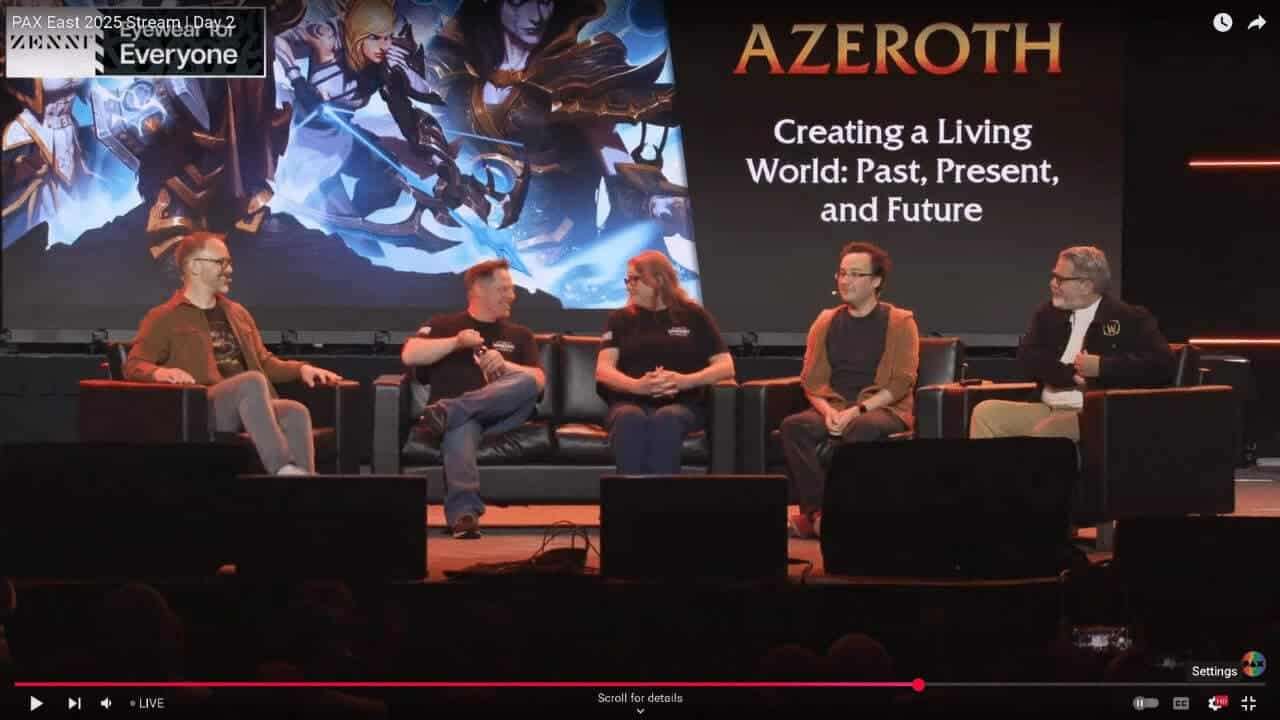
World of Warcraft is still one of the most popular and successful MMORPGs of all time. Since its release in 2004, it has seen insane commercial success, and that is largely to do with the love the various developers have for not only the game, but the community as a whole. The devs understand that MMORPGs are essentially living, breathing organisms that need to grow and change with their player base, and as the brilliant panelists of the Evolving Azeroth panel begin talking, the depth of their understanding and subsequent manipulation of this concept could not be more clear.
Adapting to Living Players
Paul Kubit, an Associate Game Director with 20 years of World of Warcraft experience under his belt, begins the Evolving Azeroth panel by outlining the basics of what makes brings the world to life – the small but delightful things such as day and night cycles, seasons and the all-important world events that he claims three people are in charge of solely creating. Jesse Kurlancheek, Principal Game Designer, then chips in that changing platforms will also change the way that people play and, thus, the way the game is designed.
These things need to work in symbiosis, but not all players can have the same experience at the same time. Paul states that the classic World of Warcraft experience, as well as the Burning Crusade expansion, had a static world, but for World of Warcraft to really continue to appeal to its players, technological advancements had to be made, and the concept of phasing was introduced within The Wrath of the Lich King. With this expansion, the world could be changed for some players but not others, depending on what they were doing and how much they engaged.
It’s a ground-breaking idea that must take serious management skills to accomplish directly, but it’s not without its flaws. Maria Hamilton, Associate Design Director, goes on to further explain the evolution of the phasing concept with the inclusion of the Party Synch, where all party members playing together will experience the same world. Thankfully, that does mean that players won’t be wandering aimlessly and yelling at each other through headsets because they can’t find that ‘ogre by the wall that you told me to meet you by’.
The Later Games Nailed It
Paul continues to say that: ‘Mists of Pandaria is where things started to coalesce.’ Everyone else on the Evolving Azeroth panel agrees that the living world is really there in that game, and Paul elaborates by saying, rather excitedly, that Midnight, the upcoming expansion, will mimic a lot of what Mists pulled off for World of Warcraft. The panelists also agree, unanimously, that Legion is another fine example of where the world and endgame content in particular, really smashed the idea of the way the world of Azeroth should change.
Jeremy Feasel, a Game Director with 15 years of experience, then speaks about: ‘how the world itself should populate the content’. Developers leave breadcrumbs for the community to make their own stories, including secrets to get the community searching and exploring all the content that might have been missed, rushing from A to B.
He expands with a humorous little anecdote regarding the first-ever puzzle, the Murdoch game in Northrend, which blew up. People got so incredibly excited about it that Jeremy tells us, with light in his eyes, about how he sought to make more of these secrets to sprinkle across the land. Engaged players make for a living world. You have to have living people inhabiting that space to make it live.
Jeremy also expounds on how they deepened the lore of the world with things like the class halls, which allowed for more nuanced character builds, and with Artefact questlines. Players would see other players with new designs and perks and say: ‘What are they doing? I want to do that too.’ And so the players, themselves, could contribute to that living space and so on.
But What If I Fly?
The Evolving Azeroth panelists then take some time to talk about the Dragonflight expansion and how that one in particular had enormous maps. That opened up the possibilities around flight, which Jesse adds, brings new dimensions to the world. The devs had to think about textures for the various builds, as well as what the players would actually see in terms of spatial continuity from the sky. Paul chimes in with an: ‘It changed the way I play zones’ comment that stretches to the player base as a whole. The game evolved, and so did the players.
Attention was then turned to the World Soul Saga of 2023 and the unusual release strategy of making it a trilogy. ‘It’s just too big,’ Maria confirms. ‘It’ll never fit into one expansion.’ Jeremy builds on this by telling the eager audience that they wanted to take a couple of big swings on experimentation after Dragonflight, so they went ahead with the trilogy idea, incorporating more content, more characters, and more places to go. The world keeps feeling bigger with each new expansion, and considering how big World of Warcraft is anyway, that’s really saying something.
Teasers and Tidbits
This enlightening Evolving Azeroth panel ends with Jeremy dropping some big news for World of Warcraft. He announces a remix for Legion, a big project considering there’s a lot of content and a lot of different systems to juggle, though he seems excited at the prospect of tackling that. He also explains that the team is currently working on an idea for Wild Item Scaling in the Mythic Keystone System, laughing as he says he’s looking forward to seeing how players break the system with how high they can go.
There is also going to be an increased difficulty option in the Shattered timeline, where everything that happened within the story of World of Warcraft is just worse. Jeremy invites us all to take the challenge and test our mettle with that one, and it’s refreshing to see how enthusiastic that challenge makes these developers.
Overall, it’s wonderful to see such a dedicated team of people committed to making sure the experience of World of Warcraft remains an organic and ever-changing monster dominating the MMORPG charts. It is the game’s living core that gives it something special, including special memories of players that have been with this expanding universe since that 2004 Big Bang.