Exploring Daggerheart’s Innovative System: Cards, Dice, and Destiny
Welcome to Daggerheart, a fantasy tabletop roleplaying game (TTRPG) that emphasizes heroic narratives and collaborative world-building. Developed by Darrington Press, Daggerheart offers a fresh take on the fantasy genre, powered by an innovative card system and the unique Duality Dice mechanic. This system is designed to seamlessly blend tactical depth with narrative freedom, empowering every player at the table to contribute to the story. The core of the gameplay revolves around the constant tension between Hope and Fear, forces that shape not only the narrative but also the mechanical outcomes of every action.
Core Gameplay Mechanics: Hope, Fear, and Duality Dice
The foundational mechanic of the Daggerheart TTRPG is its Duality Dice system. Whenever a player needs to determine the outcome of an action, they roll two 12-sided dice, a light-colored Hope die and a dark-colored Fear die. The player adds their relevant character attribute and any applicable Experience bonuses to the result. To succeed, the total must meet or exceed a difficulty threshold set by the Game Master (GM).
However, the roll’s outcome is more than a simple pass or fail. The dice introduce a narrative layer to every action. If the Hope die rolls higher, the player gains a Hope point, which can be spent later to power special abilities, assist allies, or gain an advantage. Conversely, if the Fear die rolls higher, the GM gains a Fear point.
These points are a resource for the GM to introduce complications, activate enemy abilities, or trigger environmental effects that challenge the players. This elegant system ensures that every roll has weight and moves the story forward, creating a dynamic interplay between success and consequence. You might succeed at your task but with a fearful complication, or you could fail but find a glimmer of hope in the process.
Hope and Fear points are limited, with a cap of six for both players and the GM. This encourages a fluid exchange of these resources, preventing hoarding and keeping the narrative tension high. Generally, Hope is spent more quickly by players, meaning that prolonged conflicts will naturally shift the advantage toward the GM, adding a strategic layer to every decision.
A New Approach to Initiative
One of the most discussed aspects of Daggerheart’s gameplay is its approach to initiative in combat. Instead of a traditional, rigid turn order, Daggerheart uses a more fluid system tied directly to the Fear mechanic. Players can act in any order they choose, allowing for more organic and strategic coordination. However, this freedom comes with a risk. Every action a player takes that requires a roll could generate Fear for the GM. The GM can then spend these Fear points to have enemies take actions, creating a reactive and unpredictable battlefield.
This “popcorn” style of initiative means that the more actions the players take, the more opportunities the GM has to respond. The GM can choose to spend Fear as it’s gained, creating a steady stream of counter-attacks, or save it for a more powerful, decisive blow. This system transforms initiative from a static list into an active part of the game’s risk management. Players must constantly weigh the benefits of taking another action against the potential of giving the GM more resources to use against them. It creates a tense and engaging combat experience where inaction can be as dangerous as reckless action.
Character Abilities and the Card System
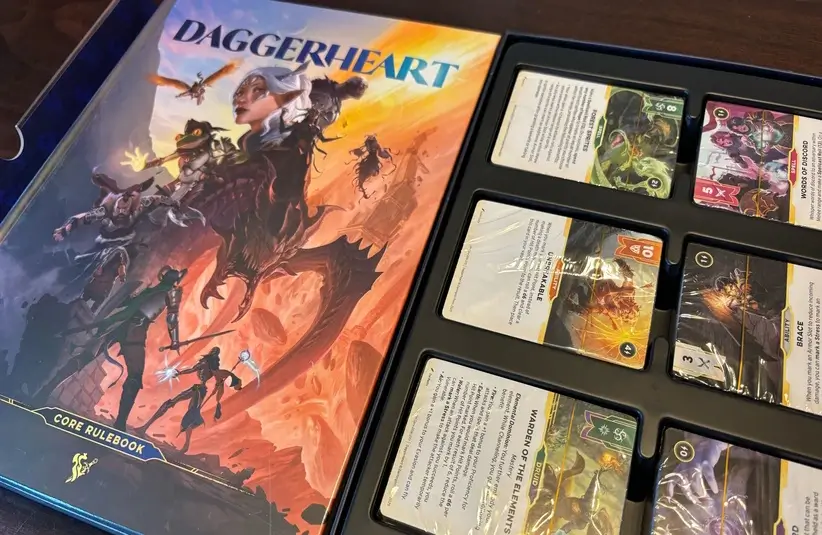
Daggerheart streamlines character management and ability tracking through a clever card-based system. Character abilities, spells, and special maneuvers are presented on beautifully illustrated cards. During character creation, players select cards from various Domains associated with their chosen class and subclass. This system makes it easy to visualize a character’s capabilities and avoids the need to constantly flip through a rulebook during play.
Each class has access to specific Domains, which are collections of themed abilities. As characters level up, they gain access to more powerful cards. A particularly innovative mechanic allows players to switch out their equipped ability cards during a session by taking on Stress, a resource representing a character’s mental and emotional strain. This adds a layer of tactical flexibility, allowing players to adapt their skill set to the challenges at hand. The cards are more than just reference material, they are a core tool that encourages players to be active and engaged, always considering their options.
Damage, Armor, and Stress
The system for handling damage in Daggerheart is detailed and offers meaningful choices. Characters have a small pool of Hit Points, but also multiple damage thresholds. Taking a large amount of damage in a single hit can cause a character to suffer more severe harm. Armor is not just a passive number, it has slots that can be marked off to reduce the level of incoming damage, making it a finite resource that must be managed.
In addition to Hit Points, characters have Stress points. Stress is a resource that can be spent to power certain abilities, but it also represents a character’s resilience. Taking minor damage can reduce Stress instead of HP. However, if all Stress points are marked, any further Stress immediately converts to HP damage. This interplay between HP, Armor, and Stress creates a nuanced system where players must make tactical decisions about when to use their powerful abilities and when to conserve their defensive resources. While some may find it a bit complex at first, the system provides a robust framework for meaningful choices in combat encounters.